Does Live Shopping Work? What Garth Brooks’ Walmart Live Event Shows Brands
Sep 29, 2026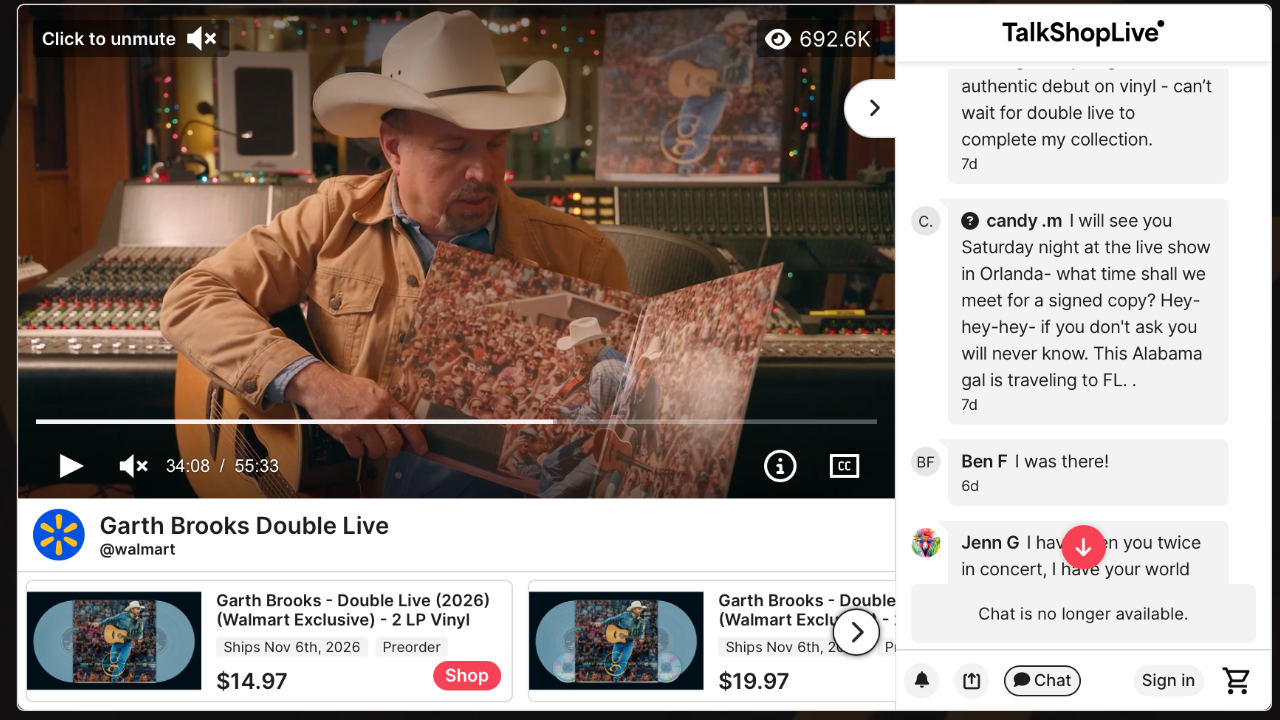
Does Live Shopping work? Yes, it can. But successful Live Shopping is about much more than turning on a camera and selling products.
The strongest Live Shopping events combine a reason to watch, real-time human connection, storytelling, an engaged audience and an easy path to purchase.
Garth Brooks’ recent Walmart Live event celebrating Double Live is a great example. It also demonstrates something brands often misunderstand about this space:
Live Shopping doesn’t have to look just one way.
Garth was in his studio performing, sharing stories and connecting with fans while special and exclusive editions of Double Live were available to purchase.
It didn’t look like QVC.
It didn’t need to.
The format was uniquely Garth Brooks, but many of the ingredients were the same ones I teach brands through my Live Shopping Method.
What Is Live Shopping?
Live Shopping combines live video, real-time audience interaction and an opportunity to purchase during or immediately following the experience.
It can be a product demonstration, fashion show, tutorial, interview, new-product launch, founder Q&A, entertainment event or something entirely different.
A beauty brand might demonstrate a skincare routine. A fashion retailer might host a new-arrivals try-on. A founder might take customers behind the scenes of a launch.
Garth Brooks performed music and told stories.
The content can look completely different while the strategy underneath it remains remarkably similar.
That is important because one of the misconceptions I still hear from ecommerce brands is that Live Shopping means standing in front of a camera holding up products and repeatedly asking people to buy.
It can.
But it certainly doesn’t have to.
What Made Garth Brooks’ Walmart Live Event a Live Shopping Event?
Look beyond what the event looked like and the Live Shopping ingredients become very clear.
There was a reason to show up. Fans were invited to celebrate an iconic album and experience live performances directly from Garth.
There was a trusted host. In this case, the ultimate host for the product was the artist himself.
There was storytelling and entertainment. The product wasn’t separated from the experience. The stories and performances gave the product context and emotional meaning.
There was real-time connection. Fans weren’t simply watching another prerecorded promotional video.
There was exclusivity. Collectible editions and Walmart-exclusive products gave fans another reason to purchase.
And, importantly, there was a clear path to purchase while interest was high.
These are many of the same elements I work through with Shopify and ecommerce brands when developing their own Live Shopping strategy.
The technology makes the transaction possible.
The technology is not the strategy.
Live Shopping Doesn’t Have to Replace What Is Already Working
Garth Brooks didn’t suddenly need Live Shopping because concerts stopped working.
It wasn’t replacing retail, social media, his website, traditional media appearances or any of the other ways he already connects with his fans.
He added another layer.
And that distinction matters for brands.
You don’t necessarily need to stop doing the marketing that is already driving results. Live Shopping can give your audience another way to experience your brand, spend time with you, learn about your products and ultimately buy from you.
In Garth’s case, there was also something incredibly powerful about where the experience happened.
He could connect with hundreds of thousands of fans from the comfort of his own studio.
Think about what that means.
An experience that might once have felt available only through a personal interaction, small event or special access can now feel intimate while being delivered one-to-many, in real time.
That ability to scale human connection is one of the biggest opportunities I see in Live Shopping and live commerce.
Does Live Shopping Actually Work?
This is usually where the conversation turns to conversion.
So let’s take the most conservative route.
Using an audience of approximately 660,000 viewers, imagine only 2% purchased.
That would be:
13,200 buyers.
Why use 2%?
Because it puts the example within the range many ecommerce brands already recognize. Shopify's 2026 ecommerce conversion data notes that global ecommerce averages commonly sit around 2% to 3%, although conversion varies significantly by product category, traffic source, price and device.
Now consider what happens when the audience isn't simply browsing a website.
They're watching someone they already know. They're engaged with the content. They're hearing the story behind the product. They can experience it in context. And in this case, they're being offered collectible or exclusive merchandise connected to someone they're already a fan of.
That is a very different shopping environment.
What Could a 2% Live Shopping Conversion Rate Mean?
Let’s stay with the conservative 2% example.
If 13,200 people purchased and we hypothetically split those customers between a $9.97 edition and a $19.97 exclusive package, the potential gross sales would be approximately:
6,600 × $9.97 = $65,802
6,600 × $19.97 = $131,802
That’s approximately:
$197,604 in potential gross sales.
At just 2%.
This is an illustration, not a claim about Garth Brooks’ actual sales from the event. We don't have his event conversion data.
But it shows very quickly why engaged audiences and Live Shopping can become commercially interesting.
And there is another factor the math doesn't account for.
Why Do Exclusive Products Work So Well With Fans?
Let's be honest.
True fans want the exclusives.
Sometimes they want more than one.
I know this because my husband is a serious RUSH fan and, trust me, we have ALL the things.
Different editions. Special releases. Collectibles. The version that apparently is completely different from the other version we already own.
Anyone who lives with a serious music fan understands exactly what I'm talking about.
That behaviour matters because a highly engaged fan or customer isn't necessarily asking the same question as a casual website visitor.
The casual shopper may be asking:
“Do I need this?”
The fan may be asking:
“Which version do I want?”
And the superfan may be asking:
“Do I need all of them?”
Exclusivity, limited editions, bundles, early access and products tied specifically to a live experience can all give an engaged audience another reason to act.
What Is a Good Live Shopping Conversion Rate?
There is no single Live Shopping conversion rate every brand should expect.
Audience quality, product category, price, offer, host, traffic source, promotion, event structure and checkout experience can all dramatically affect the result.
But we have seen Live Shopping perform well beyond conventional ecommerce benchmarks.
Shopify recently highlighted natural skincare brand Three Ships Beauty, which used live selling for a product pre-launch. According to Shopify, the event generated 1,200 unique viewers, 356 orders and $25,000 in one hour, with a reported 26% conversion rate.
McKinsey & Company has also reported companies seeing live-commerce conversion rates approaching 30%, noting that Live Shopping can shorten the journey between product discovery and purchase.
McKinsey's research into frequent live-commerce users also found reported conversion of approximately 33% among frequent U.S. live-commerce users, although that figure represents an already-engaged Live Shopping population and should not be treated as a benchmark for every livestream.
Coresight Research has separately documented significant engagement with shoppable livestreams in the U.S., including consumers watching and purchasing through live-video commerce.
Does this mean every Live Shopping event should expect 20% or 30% conversion?
No.
But it does put that intentionally conservative 2% Garth Brooks example into perspective.
What happens at 10%?
20%?
30%?
I'll let you do the math.
Does Live Shopping Have to Look Like QVC or TikTok Shop?
No.
And I think Garth Brooks is an excellent example of why.
Live Shopping is not one specific presentation style, platform or type of host.
It can happen through social media, a marketplace, a retailer such as Walmart or directly through a brand's own ecommerce website using Live Shopping technology.
For Shopify brands in particular, that opens up far more possibilities than many business owners realize.
You don't necessarily have to build your entire Live Shopping strategy around TikTok Shop.
You don't need millions of followers.
And you don't have to imitate traditional television shopping.
The question should be:
What kind of experience would make sense for YOUR customer?
Then you build the format around that.
Can Live Shopping Work for Shopify Brands?
Live Shopping can give Shopify and ecommerce brands another way to turn passive product browsing into an interactive customer experience.
Think about a traditional product page.
A shopper sees photography, product descriptions, reviews and perhaps some prerecorded video.
Now add a real human being.
Customers can see the product demonstrated. They can ask questions. They can understand sizing, texture, fit, ingredients, use cases or differences between products. They can hear the story behind an item. They can see another customer asking the same question they were wondering about.
And then they can purchase.
Live Shopping can sit alongside email, paid advertising, social media, influencer marketing, retail and traditional ecommerce.
It doesn't have to replace the customer journey.
It can expand it.
What Makes a Live Shopping Event Successful?
Going LIVE is not enough.
Successful Live Shopping usually starts well before the camera turns on.
Brands need a reason for customers to watch, the right products, an appropriate host, a clear show flow, audience engagement, compelling product storytelling and a frictionless way for customers to move from watching to purchasing.
Promotion matters.
The offer matters.
The host matters.
The customer experience matters.
And what happens after the event matters too, especially when the livestream can continue working as shoppable video or replay content.
Those are the kinds of decisions that make up a Live Shopping strategy.
They are also why choosing a platform should not be the first decision a brand makes.
Platform ≠ strategy.
How Can a Brand Get Started With Live Shopping?
Start with your customer, not the technology.
Ask:
Why would someone want to watch?
What can we give them through a live experience that they cannot get from another Instagram post or product page?
Which products lend themselves to demonstration, explanation or storytelling?
Who is the right person to host?
What questions are customers already asking before they buy?
Is there an exclusive, bundle, launch, limited edition or other reason to act?
And what happens when someone decides they want the product?
Once those answers are clear, choosing the technology becomes significantly easier.
That is also why Garth Brooks’ Walmart Live event is such a useful example.
His version of Live Shopping made sense for his product, his audience and his brand.
Yours should too.
Live Shopping FAQ
What is Live Shopping?
Live Shopping combines live video, real-time interaction and ecommerce, allowing viewers to discover products, ask questions and purchase during or after a live experience.
Does Live Shopping work?
Live Shopping can generate strong engagement and sales when the audience, product, host, content, offer and buying experience are aligned. Results vary significantly, which is why simply starting a livestream does not guarantee conversion.
What is the average Live Shopping conversion rate?
There is no universal Live Shopping conversion rate. Shopify has documented individual Live Shopping events with conversion above 20%, while McKinsey has reported companies seeing conversion rates approaching 30%. These should be viewed as examples rather than guaranteed benchmarks.
Does Live Shopping have to happen on TikTok Shop?
No. Live Shopping can happen through social platforms, retail marketplaces and ecommerce websites using shoppable video or Live Shopping technology. Shopify brands can also host Live Shopping experiences directly within their own ecommerce ecosystem.
Can a small ecommerce brand use Live Shopping?
Yes. Live Shopping is not dependent on having hundreds of thousands of viewers. A smaller, highly relevant audience can be commercially valuable when the products, content and shopping experience are aligned.
Do I need a professional host for Live Shopping?
Not necessarily. A founder, employee, creator, ambassador or professional host can all be effective. The right choice depends on the brand, audience and objective. What matters is that the person on camera can communicate naturally, demonstrate product value, interact with viewers and confidently move the conversation toward purchase.
How do I start Live Shopping for my Shopify store?
Begin with your objective, audience and product rather than choosing a platform first. Determine why customers would watch, what products you will feature, who will host, how you will promote the event and how viewers will purchase. Then choose the technology that supports that strategy.
Want to Start Live Shopping for Your Shopify Brand?
Live Shopping doesn't have to look like Garth Brooks’ event, QVC, TikTok Shop or anyone else's.
It should make sense for your products, your customers and your brand.
Through Live Selling School, I help Shopify and ecommerce brands develop the strategy, on-camera skills, show flow and technology needed to create Live Shopping experiences designed to connect and convert.
Whether you want to train someone already on your team or need help building your Live Shopping strategy and activation from beginning to end, the goal is the same:
To give your customers another reason to spend time with your brand and another opportunity to buy.
Ready to explore what Live Shopping could look like for your brand?
Check out my Small Business Guide to Livestream Shopping and of course reach out to me at dawn@livesellingschool.com if you need any additional insight and information.
Sources: Garth Brooks official website; Shopify, Live Selling in 2026: How To Boost Engagement and Sales and Ecommerce Conversion Rate: Benchmarks & Tips (2026); McKinsey & Company, It’s Showtime! How Live Commerce Is Transforming the Shopping Experience and Realizing the Potential of Live Commerce; Coresight Research, U.S. Livestreaming Research.
SUBSCRIBE TO THE BLOG
We hate SPAM. We will never sell your information, for any reason.
